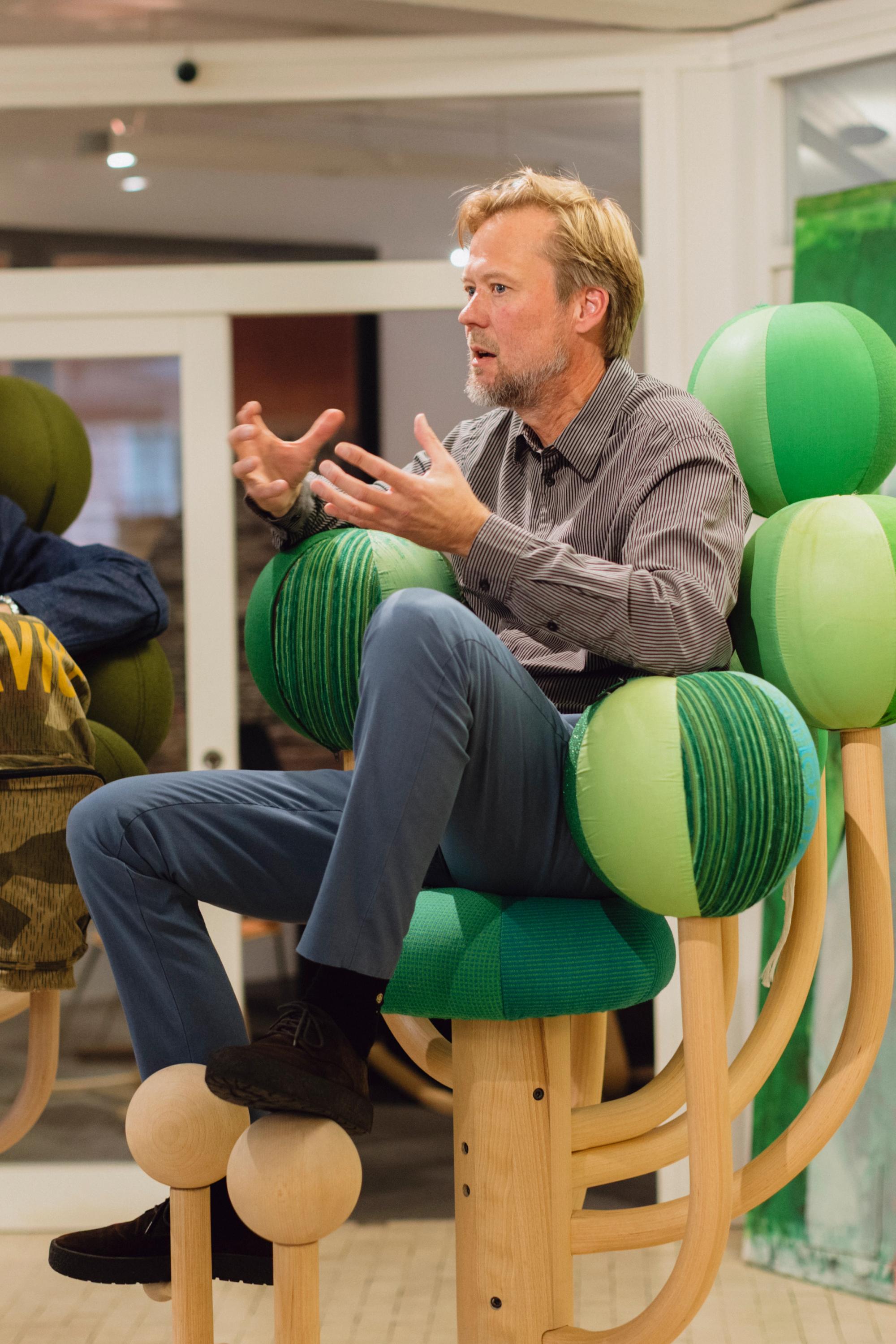
In conversation with Tor Opsvik

During Designers’ Saturday in Oslo, we had the pleasure of hosting a conversation between interior architect Fredrik Bull and Tor Opsvik, son of Peter Opsvik and head of Peter Opsvik AS. In the studio where Peter spent decades developing groundbreaking designs, the conversation unfolded around memories, philosophy, and the belief that the best sitting position is always the next one.

PHOTOS BY JOHANNE NYBORG

Can you tell us a little about Peter?

Peter was born in 1939 in Stranda, a small village in northwestern Norway with about 4,000 inhabitants, and at least five furniture factories. His father, Nils, started a furniture factory together with a neighbour in the 1920s. It went bankrupt during the economic crisis of the 1930s. After the war, he started a new furniture factory with his brother, and this time it succeeded. During Peter’s military service, his father sent him an application form for the design program at the arts and crafts school. That was how his design journey began.

How do you remember Peter?

As a child, I thought of my father more as an inventor than as a designer. I don’t think I even knew the word “designer” until I was a teenager. He constantly questioned things. Why is this object made like this? Why do we do things this way? There must be a better solution. In his later years, he was several times admitted to hospital. Each time he returned with a head full of new ideas for improving hospital equipment. He was obsessed with finding good solutions. That some of his best moments were when an idea was so good he couldn’t sleep at night - he would just lie awake waiting for morning so he could explore it further. “If you get an idea and sleep well through the night, then the idea probably isn’t good enough.

"He constantly questioned things. Why is this object made like this? Why do we do things this way? There must be a better solution.”

It seems Peter preferred letting his work speak rather than talking about himself?

That’s true. Two years ago, an art historian wanted to write a book about his life and work, but he declined. He said: “My thoughts and the results of my work can be found in Rethinking Sitting, and I don’t want my person, who was I, to get in the way of that.” Maybe I’ve already told you more about who he was than he would have appreciated.


How did Peter think about form and function?

He was a functionalist in the sense that function should guide design - form follows function. But he did not take function for granted. Often, he started by asking what the function could be. A chair that grows with the child did not exist before he designed Tripp Trapp in 1972. However, some of his designs were also visual explorations without a clear functional purpose. At times, he worked more like an artist than a designer - someone creating out of curiosity and passion. I think this freedom was important for giving his chairs their strong visual expressions.

Why chairs?

I wasn’t born when he started designing chairs, so I don’t know exactly why he began. But I know why he continued. He had new and groundbreaking ideas about sitting itself. In the 1970s, ergonomists were still debating the best sitting posture. Some argued for a slightly reclined posture, others for a forward leaning posture with an open hip angle. Peter believed that the best sitting posture is the next one. Even the most comfortable position becomes uncomfortable after a while.


Our bodies are made for movement. The function of a chair should be to allow movement even while sitting. He often said: “If you are allowed to move, you move.” That is why he designed chairs that follow the body’s desire for movement rather than locking it into one position.

"He constantly questioned things. Why is this object made like this? Why do we do things this way? There must be a better solution.”

Peter talked about sitting with our feet. What did he mean by this?

When Peter explored movement further, he made an interesting observation. When we sit well, we don’t really sit on our bottoms - we sit with our feet. We use our feet to move and vary between positions. We tend to place our feet firmly on the floor when sitting in the typical 90-degree posture between calves, thighs, and torso.


But in reality, people rarely sit that way for long. People often lean back and use only the upper part of the backrest, or lean forward without using the backrest at all. In a way, people only sit “correctly” in stores when trying a chair, because that is what they have learned is the correct posture.
You can see this idea reflected in saddle-like seating positions, inspired partly by riding posture. Historically, horseback riders were probably the first longtime sitters. They sat in balance, with an open hip angle, and with the invention of the stirrup they also gained foot control. This is three key elements for active sitting.

The design of some chairs looks almost radical, with cut-outs and open shapes. Why is that?

Chairs are a bit like parenting. A good chair should support you in the right places, but it is easy to forget that support can also reduce freedom. That is why many of Peter’s chairs have cut-outs. Support is carefully placed, while other areas are left open to allow movement. For example, remove the armrests on some designs and the cut-outs in the backrest become elbow rests.

"Peter wrote a whole book about sitting and the function of chairs. When it came to form, he preferred to say as little as possible. That does not mean he was not deeply interested in visual expression.”

Some of Peter’s designs challenged traditional ideas of form. Was form purely a result of function?

Peter wrote a whole book about sitting and the function of chairs. When it came to form, he preferred to say as little as possible. That does not mean he was not deeply interested in visual expression. He saw the chair as something between architecture and clothing, softer than the building you live in, but more structured than clothing. He explored the space between categories. Everything between a building and a garment could be a chair. He also worked with cabinets that were more like wall art than storage, because their capacity was intentionally limited. There was a message there about living with fewer things, but sometimes it was simply because he enjoyed playing in that space between art and furniture.

Before we finish, could you briefly tell us a little about the future of the studio and the company Peter Opsvik?

The work continues. The studio will carry forward and further develop Peters ideas on sitting with movement and variation, not as trends, but as principles. The basic idea is simple: when we are allowed to move, we move.

"The work continues. The studio will carry forward and further develop Peters ideas on sitting with movement and variation, not as trends, but as principles. The basic idea is simple: when we are allowed to move, we move.”