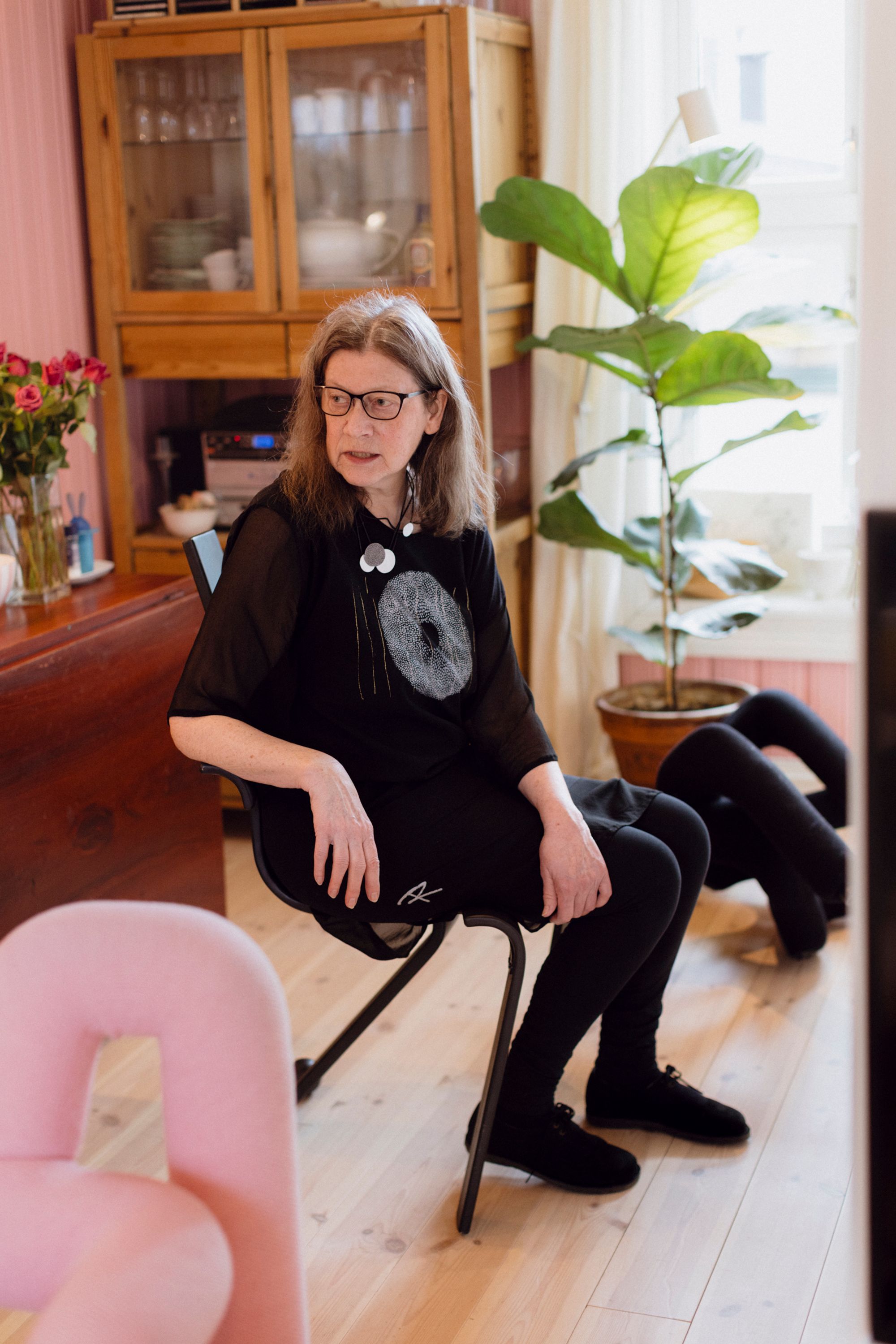
Janne already knew who Terje was before they met. She worked within design education at Oslo Metropolitan University, and had followed his work from a distance. A portait of him in an interior magazine caught her eye. Their first meeting happened by chance. She had just gotten a new car and planned to drive to her cabin. Sitting outside the entrance to her Oslo apartment was Terje, having a beer. “I said: “I’m sorry to have to ask the man who designed such a beautiful chair to move.” She smiles at the memory. “It was actually quite a good line. He liked attention for the chair.” Since then they were inseparable.
Creativity that refused to follow
On a small street in Rodeløkka, Oslo, stands the house where Janne Reitan lived with Terje Ekstrøm. She still lives there, now in a smaller apartment with bright pink walls, a contrast to the natural pine interiors they once shared . Through her memories, a portrait emerges of the man behind the Ekstrem™ chair. “Creative,” she says. “In everything.”
Photos by Johanne Nyborg
Living with Terje also meant living with his ideas. Chairs, prototypes and experiments always filled their home. The distinction between workshop and living space was non-existent. “There were chairs everywhere,” she says. “Not just in the workshop. In the living room, around the house. He liked having them around so he could look at them, at all times.”
“There were chairs everywhere. Not just in the workshop. In the living room, around the house. He liked having them around so he could look at them, at all times.”
Although Terje had the opportunity to continue the family’s cabinetmaking business, he chose another path. He wanted to work independently as a designer. The craftsman’s way of thinking stayed with him, but he did not want to run a workshop in the traditional sense. Instead, he developed ideas by building full-scale prototypes, and sometimes small-scale versions as the first step, skipping sketches altogether. “When he had an idea, he thought about it first, and then started working with the material,” Janne says. His design process was creating two prototypes at the same time - one to test function, and one to explore the visual expression. Some of these early experiments were not yet meant to be sat on, and with the chairs left around the house, accidents could happen: "A few guests ended up on the floor when they tried to test a chair while we weren’t around to warn them" she laughs.
Despite the playful appearance of many of Terjes designs, his thinking was always grounded in function. According to Janne, that was the single most important principle behind his work. “He couldn’t stand objects that were only meant to look pretty,” she says. “That was the worst thing he knew.” This philosophy also shaped the development of Ekstrem™. The chair is often described as sculptural, but for Terje the form was never the starting point. “For Terje, function always came first,” Janne says.
The chair was designed to support the body in many different positions. The soft, padded structure allows the user to lean, turn, or sit sideways, while remaining supported. “It supports you exactly where you need it,” she says. “That’s why it feels so good to sit in.”
The chair was designed in 1972, but it did not enter production until 1984. According to Janne, the manufacturers struggled to understand it at the time. “The people who were selling it didn’t really know how to relate to it,” she says. “It didn’t look like anything they were used to.”
“He couldn’t stand objects that were only meant to look pretty. That was the worst thing he knew.”
Ekstrem™ also stood apart from many of the other chairs being produced in Norway at the time. While several designs from the period explored mechanical movement, Terje approached movement differently. “The chair itself doesn’t move. But it allows the person sitting in it to move.” The structure offers support in unexpected ways, something many only discover when they try it. “Many think it is just a sculpture,” she says. “But when they sit in it, they realize how comfortable it actually is.”
Janne knows this from experience. She has lived with the chair for many years and uses it both at home and at her cabin. “I have a bad back,” she says. “It’s actually the only chair I can sit in without pain.” Terje himself also believed the chair could work well for older users. “You can place your feet underneath you when you want to stand up,” she explains. “In many chairs you have to lean forward first, but here you can rise more directly. While using the back and armrests for support”.
The living room remains filled with prototypes, as Janne shows how the pieces lock into place, something that wasn’t always obvious, as a few guests learned the hard way.
Despite its unconventional form, Ekstrem™ was never intended as a purely visual object. Janne explains that this misunderstanding is partly connected to how the chair has been described over the years. “Many people call it postmodern. But Terje strongly disagreed with that.” She explains. Ekstrem™ was designed in 1972, before postmodern design and the Memphis movement began to influence furniture design in the 1980s. For Terje, the chair belonged much more clearly to a modernist tradition.
“In modernism, function is always important,” Janne explains. “The visual expression is part of it, but the object must work.” Postmodern design often placed greater emphasis on visual expression, sometimes independent of function. Terje felt that describing Ekstrem™ as postmodern misunderstood the thinking behind it. “Function was always the starting point for him.”
“Terje believed the designs should speak for themselves. He talked about the ideas behind them, but he wasn’t someone who pushed himself forward.”
The wooden sink in the bathroom was made by Terje Ekstrøm himself. It also doubles as a showerhead, reflecting his appreciation for practical and simple solutions.
At the same time, the chair clearly introduced a visual language that many people had never seen before. According to Janne, this may also explain why manufacturers struggled to position it when it first entered production. “The people responsible for selling it didn’t really know how to talk about it,” she says. “Architects and designers appreciated it, but the manufacturers didn’t always follow up.”
Terje himself was not particularly interested in promoting his work. “He believed the designs should speak for themselves,” Janne says. “He talked about the ideas behind them, but he wasn’t someone who pushed himself forward.” Originality was something he valued deeply. Copying the work of others was something he strongly disliked. In recent years, the attention around Ekstrem™ has grown. “What Terje worked for all those years is really happening now,” she says. “I’m very happy about that.”